 01
Shockwave when loading has plateaued
Acoustic pressure waves are applied over the tender section of the tendon in short weekly sessions, while the loading program continues.
Read about acoustic sessions for pain just below the kneecap.
Science-Backed, Innovative Care in Leesburg, FL. Schedule Your Appointment.

A sharp, pinpoint pain just below the kneecap on stairs, squats and jumps. Tendons respond to the right load. Care here builds that load and adds treatment when the tendon has stopped improving.
Patellar tendinopathy is an overloaded, painful tendon between the kneecap and the shin bone, often called jumper's knee. It usually responds to a structured tendon loading program. Revive by MWS in Leesburg may add shockwave, a platelet preparation or knee unloading when the tendon has stalled.
Pain from the patellar tendon is easy to point to. It sits in a small spot just below the kneecap. It bites at particular moments: the first stair down, the drop into a squat, the push off in a pickleball rally.
It often warms up and eases during activity, then returns the next morning, stiffer and sorer. That pattern tempts people to keep playing, and over months the tendon becomes less and less tolerant.
At Revive by MWS in Leesburg we measure how much load the tendon can currently take, then build it up with a structured program. Complete rest rarely helps a tendon for long. Where the tendon has stopped responding to good loading, shockwave or a platelet preparation may be considered alongside it.
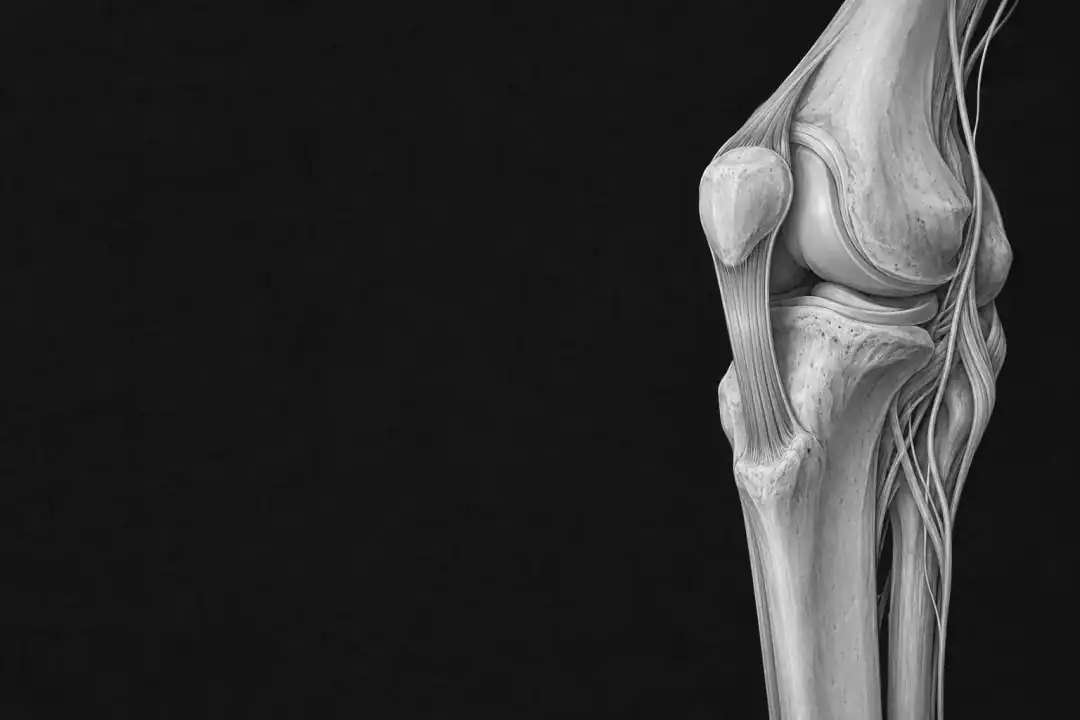
Patellar tendinopathy is a load-related problem in the tendon that connects the kneecap to the shin bone. Repeated jumping, squatting and stair work overload the tendon faster than it adapts, and it becomes thickened, sensitive and painful.
Every jump, stair descent and squat loads the patellar tendon like a spring. It handles steady increases well and sudden spikes poorly.
When load outpaces recovery, the tendon fibers become disorganized and the tendon thickens. Pain appears at the point just below the kneecap.
Stopping all activity calms the pain for a while but weakens the tendon. Pain returns quickly when activity restarts.
Pickleball, tennis and basketball load the tendon repeatedly. A jump in playing time, such as a tournament week, often starts it.
New classes, hill walking or a return to sport after a break raise the load faster than the tendon can adapt.
When the quadriceps and hip muscles tire, the tendon takes more strain. Strength often drops without being noticed.
Tight muscles at the back of the leg change how the knee absorbs landing forces, loading the front of the knee more.
Hard courts and worn-out shoes increase the impact passed to the tendon with every landing.
We press along the tendon to find the tender point. Pain just below the kneecap is typical and separates it from kneecap joint pain.
A single-leg squat on a slope loads the tendon in a controlled way. Your pain score becomes a baseline for progress.
Quadriceps, hip and calf strength and hamstring flexibility are checked. Weak links feed directly into the loading plan.
Ultrasound can show tendon thickening and changes in the tissue. It also rules out a partial tear before any treatment.
Approaches we may consider, depending on what the evaluation finds.
Patellar tendinopathy at Revive by MWS is treated around a structured loading program. Shockwave is considered for a stalled tendon and PRP or PRF for persistent cases. Knee joint decompression is an option where joint loading adds to pain at the front of the knee.
01 Acoustic pressure waves are applied over the tender section of the tendon in short weekly sessions, while the loading program continues.
Read about acoustic sessions for pain just below the kneecap.
 02
For tendon pain that has not responded to loading and shockwave, a preparation from your own blood may be placed at the tendon under ultrasound guidance.
Read when a platelet preparation is placed at the patellar tendon.
 03
Where pressure through the knee joint adds to the pain, short sessions of controlled traction may be used to take load off the joint.
Read about gentle knee unloading when joint load adds to tendon pain.
A tendon becomes stronger when it is loaded steadily and progressively. That is why a structured exercise program is the center of care for patellar tendinopathy.
Treatments such as shockwave are there to help a tendon that has stalled, not to replace the exercise.
The Mayo Clinic overview of patellar tendinitis describes the symptoms, the risk factors and the role of physical therapy in treatment.
It places strengthening at the start of care, which matches the plan we build around every tendon.
What to try first, and what should not wait.
Reduce jumping and deep squats for a few weeks, but keep the tendon working. Wall sits held for thirty to forty-five seconds are a common, tendon-friendly starting exercise.
Build activity back gradually rather than returning to full play at once. Pain up to a mild level during exercise is acceptable if it settles by the next morning.
Tendon problems improve on load, not on rest. The evaluation here measures what your tendon tolerates today and sets a starting point, so treatment and exercise work together.
The complimentary consultation includes a decline squat test and a check of thigh and hip strength.
Getting here from around Lake and Marion County.
Revive by MWS is at 920 E. Dixie Ave. Suite A in Leesburg, near Lake Harris. Players with tendon pain come from The Villages, Lady Lake, Clermont, Eustis and Mount Dora. Wear shorts or loose pants so the knee can be examined easily.
 The Villages Patients from The Villages
 Lady Lake Patients from Lady Lake
 Ocala Patients from Ocala
 Mount Dora Patients from Mount Dora
 Clermont Patients from Clermont
 Eustis Patients from Eustis
 All areas we serve Lake County and Marion County
Also serving Fruitland Park, Tavares, Belleview, Summerfield, Ocklawaha
Usually you reduce rather than stop. Cutting back jumping and match play while following a loading program keeps the tendon strong. Complete rest often leads to a flare on return.
It is the common name for patellar tendinopathy, pain in the tendon just below the kneecap. It affects jumpers but also walkers, stair climbers and racket players.
Tendons adapt over months, so most loading programs run for twelve weeks or longer. Results vary by individual and are tracked with a squat test.
Yes, it is commonly used for tendons that have stalled despite exercise. It is added to the loading program rather than used on its own.
A strap below the kneecap helps some people during activity by changing how load reaches the tendon. It eases symptoms but does not replace strengthening.
Tell us what is going on and we will find a time. The first appointment is an evaluation and a conversation, and provider time for it is not charged.
A few details about what hurts and when it started. Nothing is scheduled until we have spoken.
Our team confirms a time that works and tells you what to bring, including any imaging or records.
After the evaluation we explain what we found and which options may help. Results vary by individual, and you decide what happens next.
Send the form and the office team will call you back to confirm a time that works. There is no charge for the consultation and no obligation to start care.
Prefer to call? (352) 559-1901. 920 E. Dixie Ave. Suite A, Leesburg, FL 34748.
The booking form needs JavaScript. If it does not appear, call the clinic and we will book you in.
Revive by MWS is conveniently located to serve patients from Fruitland Park, Lady Lake, Tavares, Mount Dora, and Eustis, as well as the surrounding Lake County area.
Schedule a complimentary consultation with Revive by MWS and we will build an individualized care plan around what we actually find. Provider time for that first evaluation is not charged.
Book a complimentary consultationBook your consultationYour privacy choices
We use cookies and analytics to see how this site is used. Nothing optional runs until you choose. Privacy policy