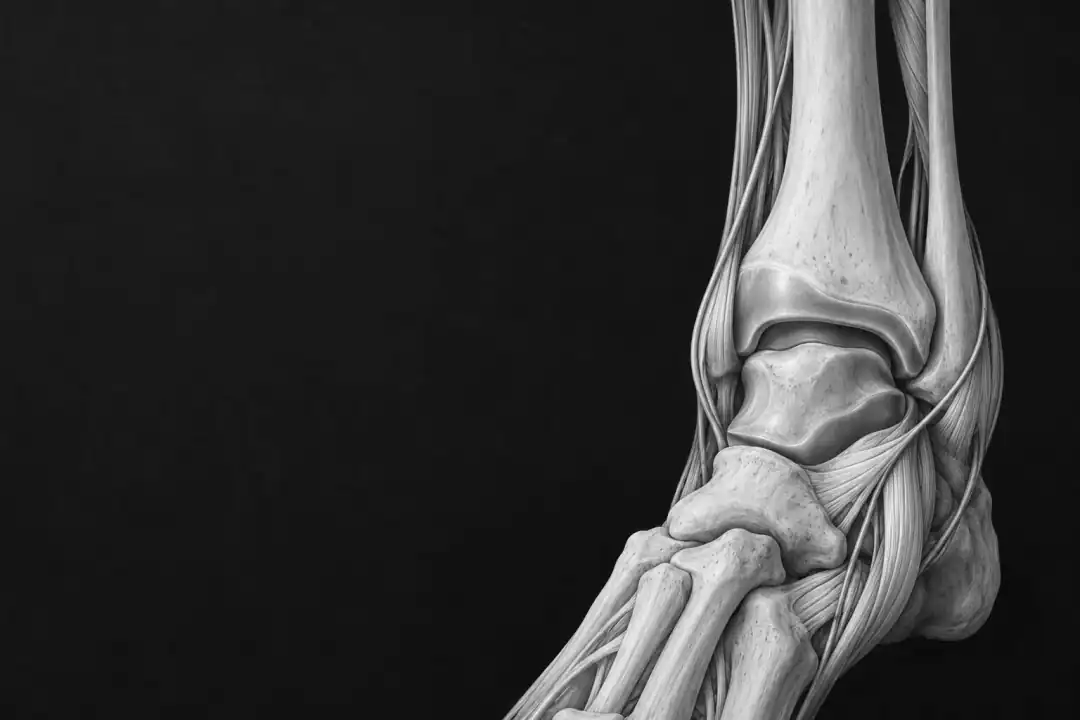
Quick summary Foot and ankle arthritis is wear in the ankle, the midfoot or the big toe joint, causing stiffness, swelling and pain on walking. Many cases follow an old sprain or fracture. At Revive by MWS in Leesburg, orthobiologic placement or laser may be considered alongside footwear and walking changes after an examination.
The foot has thirty-three joints, and arthritis tends to settle in three places. The ankle, the midfoot arch and the big toe joint at the base of the toe take the most load with every step.
Ankle arthritis often follows a bad sprain or a fracture from years ago. Midfoot arthritis shows up as an aching bony bump on top of the foot. Big toe arthritis makes pushing off painful, and many people start walking on the outside of the foot to avoid it.
At Revive by MWS in Leesburg we look at the joint, the shoes and the way you walk. A small change in footwear or a stiff-soled shoe can take real load off an arthritic joint. When that is not enough, orthobiologic or laser options may be considered alongside it.
Understanding Foot and Ankle Arthritis
Foot and ankle arthritis is cartilage wear in the joints that carry body weight during walking. It causes pain, swelling and stiffness at the ankle, the top of the midfoot or the big toe. It often develops years after an injury to that joint.
How it works
Old injuries change the joint surface
A fracture or repeated sprains can leave the joint surfaces slightly uneven. Uneven surfaces wear faster over the following decades.
Stiffness shifts the load elsewhere
A stiff big toe or ankle forces the foot to roll differently. Other joints and the knee then take strain they were not built for.
Bone spurs block movement
Spurs form at the edges of worn joints. On top of the big toe or the front of the ankle they can pinch with every step and rub on shoes.
Who this care helps
- Aching and stiffness in the ankle, midfoot or big toe on walking
- Swelling after being on your feet for a few hours
- Arthritis in a joint that was sprained or broken years ago
- Imaging that shows wear matching where it hurts
- People wanting to delay or avoid a fusion or joint replacement
Who it does not help
- A hot, red, very swollen joint that appeared within a day, which can be gout or infection
- A foot wound or ulcer, especially with diabetes
- A foot that suddenly changes shape or collapses, with or without pain
- Pain after a recent twist that prevents putting weight on the foot
Common Symptoms
- Pain deep in the ankle when walking on uneven ground
- An aching, bony bump on the top of the midfoot
- A stiff big toe that hurts when you push off
- Swelling around the ankle by the end of the day
- Stiffness after sitting that eases after a few steps
- Rubbing or pressure from the top of shoes
- Walking on the outside edge of the foot to avoid pain
- Difficulty on stairs, slopes or sand
Common Causes
01 An old ankle fracture or sprain
Most ankle arthritis follows an injury rather than simple aging. It can appear ten to twenty years after the original break or repeated sprains.
02 Wear at the big toe joint
The joint at the base of the big toe bends with every step. It commonly develops arthritis and bone spurs, a condition often called hallux rigidus.
03 Flat feet and arch collapse
A flattening arch changes the load on the midfoot joints. Wear in those joints produces the bony, aching bump on top of the foot.
04 Inflammatory arthritis and gout
Rheumatoid arthritis often affects the feet early, and gout classically strikes the big toe. Both need their own medical management.
05 Body weight and years on the feet
Each step puts more than body weight through the ankle. Extra weight and years of standing work add up across those joints.
How Revive Evaluates Foot and Ankle Arthritis
- 01
Locating the joint involved
Ankle, midfoot and big toe arthritis each hurt in a different spot. We press and move each joint in turn to find the one reproducing your pain.
- 02
Watching you walk
We look at how the foot lands, rolls and pushes off. Changes in walking often explain pain in the knee or hip as well.
- 03
Your shoes
We check the shoes you wear most days for sole stiffness, toe room and wear patterns. Shoes are often part of the plan.
- 04
Screening for other causes
Gout, inflammatory arthritis, circulation and nerve sensation are considered. Findings that point elsewhere lead to the right referral.
Treatment Options We May Consider
Approaches we may consider, depending on what the evaluation finds.
Foot and ankle arthritis at Revive by MWS is treated alongside footwear and walking changes. Orthobiologic placement is considered for a painful ankle or toe joint, and laser as a gentle option for aching and swelling around the joint.
 01
Orthobiologic placement in a worn foot joint
 02
Laser for aching and swelling
Why shoes come first
An arthritic foot joint hurts most when it has to bend under load. A shoe with a stiff, rocker-shaped
sole lets you roll through a step without bending the painful joint as much.
That single change often helps more than people expect, and every plan written here considers it.
The OrthoInfo guide to arthritis of the foot and ankle
describes the common types, the joints most often involved and the non-surgical and surgical
options.
It reflects the order we follow: footwear, activity changes and other non-surgical care first, with
surgery kept for pain that still limits daily life.
What to Try First, and When to Seek Care
What to try first, and what should not wait.
Choose shoes with a firm, slightly rocker-shaped sole and room for the toes. A stiff sole limits painful bending at the big toe and midfoot.
Swap long walks on sand or slopes for flat paths, and try cycling or water exercise on bad days. Raising the foot in the evening helps with swelling.
Signs that should not wait
- A joint that turns hot, red and very swollen within hours
- Any foot wound, especially if you have diabetes or reduced sensation
- A foot that suddenly changes shape or flattens
- Being unable to put weight on the foot after a twist or fall
Expert Care for Foot and Ankle Arthritis in Leesburg
Foot arthritis is as much about how you walk as about the joint itself. The evaluation here looks at the joint, the shoes and the walking pattern together, so the plan addresses all three.
The complimentary consultation includes a walking assessment. Bring the shoes you wear most often.
Further reading: the OrthoInfo guide to arthritis of the foot and ankle
Updated September 25, 2026