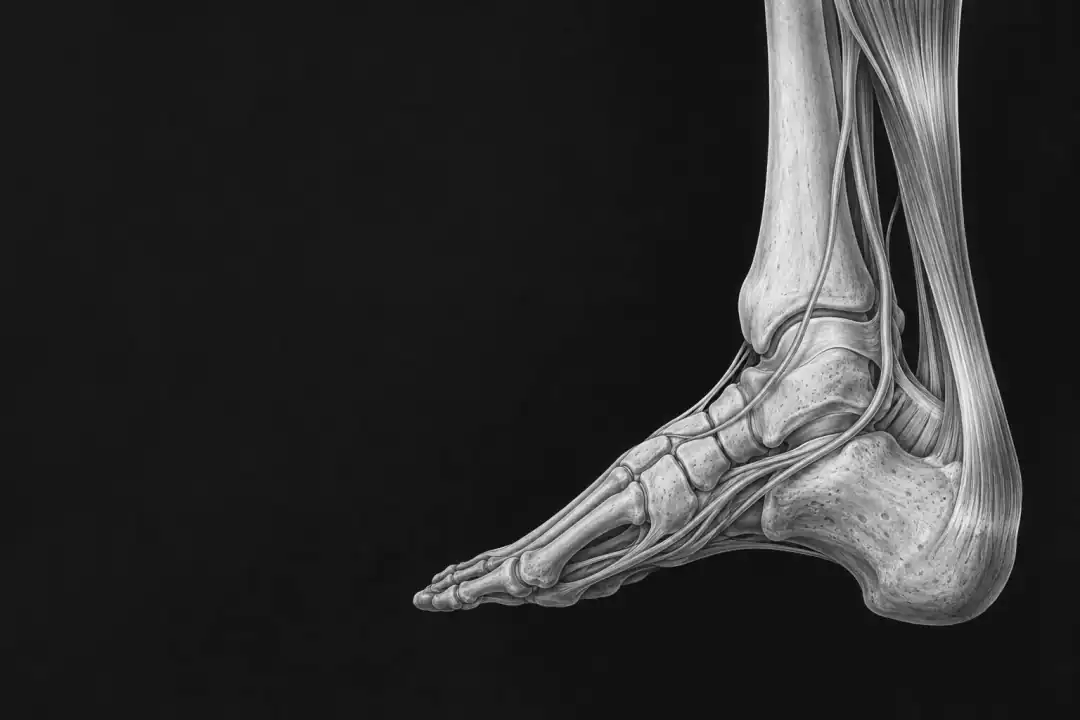
Quick summary Achilles tendinopathy is a painful, thickened Achilles tendon, usually from load the tendon could not keep up with. Most cases improve with a graded calf-loading program. At Revive by MWS in Leesburg, shockwave or a platelet preparation may be added when the tendon has stalled despite well-run exercise at home.
The Achilles is the thick cord that joins the calf muscles to the heel bone. When it becomes irritated it usually announces itself first thing in the morning. The first dozen steps are stiff and sore, then it loosens, then it aches again that evening.
Many people keep walking through it for months. Some rest it completely, which feels sensible and usually makes the tendon weaker. Others have tried heel lifts, new shoes and a few weeks of stretching without much change.
At Revive by MWS in Leesburg we start by finding exactly where the tendon hurts. Pain in the middle of the cord and pain right where it meets the heel behave differently. They also respond to different exercise, which shapes everything else in the plan.
Understanding Achilles Tendinopathy
Achilles tendinopathy is a load problem in the tendon between the calf and the heel. The tendon thickens and becomes painful when the demand placed on it outpaces its ability to adapt. It is managed by loading it correctly, not by resting it.
How it works
The tendon adapts slowly to load
Tendons have a modest blood supply and remodel over months rather than days. A sudden jump in walking, a new hill route or a change of shoes can outpace that process.
The tissue thickens and gets sensitive
The overloaded section swells and becomes tender to squeeze. It often feels like a lump in the cord a few finger widths above the heel.
Rest weakens it further
A tendon that is never loaded loses tolerance. That is why the pain returns quickly when activity restarts after a few weeks off.
Who this care helps
- Morning stiffness at the back of the heel that eases after a few minutes
- A tender thickening in the cord above the heel
- Pain that has lasted more than three months despite a home program
- Walkers, golfers and pickleball players who want to keep playing
- People wanting a non-surgical option before a surgical opinion
Who it does not help
- A sudden snap or a feeling of being kicked in the heel, which suggests a rupture
- Inability to rise onto the toes of the affected foot
- A hot, red and swollen calf, which needs same-day assessment
- Heel pain on the underside of the foot, which is a different problem
Common Symptoms
- Stiffness at the back of the heel with the first steps of the day
- Pain that eases once you get moving, then returns later
- A tender, thickened area a few finger widths above the heel
- Soreness after walking uphill or climbing stairs
- Pain where the cord attaches to the heel bone
- A creaking sensation when the ankle moves
- Weakness when rising onto the toes on the sore side
- Discomfort from the back of a shoe pressing on the heel
Common Causes
01 A sudden rise in walking or activity
A new exercise class, a vacation with a lot of walking or a return to pickleball after a break can load the tendon faster than it adapts. This is the most common story we hear.
02 Stiff or weak calf muscles
When the calf tires early, the tendon takes more of the strain. Calf strength declines steadily after fifty, which is part of why this problem is so common in our patients.
03 Footwear changes and flat shoes
Moving from a supportive shoe with a heel to a completely flat sandal increases the stretch on the tendon with every step. The change often comes shortly before the pain starts.
04 Certain medications and medical conditions
Some antibiotics in the fluoroquinolone group are linked to tendon problems, as are diabetes and some cholesterol conditions. We ask about each one at the first visit.
05 Pressure at the heel attachment
Where the tendon inserts into the heel, a bony prominence or a stiff shoe counter can compress it. Insertional pain needs a different exercise approach from mid-tendon pain.
How Revive Evaluates Achilles Tendinopathy
- 01
Finding the sore point along the cord
We pinch along the cord to find the sore point. Mid-tendon and insertional problems are separated at this step, because the loading program differs between them.
- 02
How much load the tendon tolerates
We count single-leg heel raises on each side and watch for a hop or a limp. The difference between the two legs is a useful starting number.
- 03
Ruling out a tear
A squeeze test on the calf checks the tendon is intact. Any doubt about a rupture means an urgent referral rather than a treatment plan.
- 04
What changed before it started
Shoes, routes, new activities and recent medications are all reviewed. The trigger often points to the simplest part of the fix.
Treatment Options We May Consider
Approaches we may consider, depending on what the evaluation finds.
Achilles tendinopathy at Revive by MWS is treated around a graded loading program. Shockwave therapy is considered for a tendon that has stalled despite good exercise, and a platelet preparation from your own blood is considered for selected persistent cases.
 01
Shockwave for a tendon that has stalled
 02
A platelet preparation for persistent cases
Why the morning matters so much
The first steps of the day are the most useful measure we have for an Achilles problem. We ask how
long the stiffness lasts and how many steps it takes to loosen.
As the tendon improves, that window shortens. It often changes before the pain during activity does.
What the evidence says about loading the tendon
The MedlinePlus encyclopedia entry on Achilles tendinitis
describes the usual causes, the symptoms and the home measures that help most people.
Its core advice matches ours: reduce the activities that flare it, keep the calf working, and give
the tendon enough time to adapt.
Where treatment fits
Shockwave and platelet preparations are considered for tendons that have stopped improving. They are
not a shortcut past the exercise, and every plan written here includes a loading program.
What to Try First, and When to Seek Care
What to try first, and what should not wait.
Keep the tendon working rather than resting it completely. Slow heel raises on a step, done within a level of discomfort you can tolerate, are the usual starting point.
Swap very flat shoes for ones with a small heel for a few weeks. Shorten walks rather than stopping them, and avoid hills and sand until the morning stiffness settles.
Signs that should not wait
- A sudden pop or snap at the back of the ankle, with difficulty walking afterward
- Being unable to stand on tiptoe on the affected side
- A calf that becomes hot, red, swollen or tender to touch
- Heel pain with fever or a feeling of being generally unwell
Expert Care for Achilles Tendinopathy in Leesburg
Achilles pain is one of the problems where exercise does most of the work. Our part is to find which section of the tendon is involved, set the right starting load and decide whether a device or injection adds anything.
The complimentary consultation includes the heel raise count and a check that the tendon is intact.
Further reading: the MedlinePlus encyclopedia entry on Achilles tendinitis
Updated September 25, 2026